
This article will help you understand realistic salary ranges and factors that influence pay. It also explains salary trends.
You’ll learn what to expect and how to negotiate. You’ll also know how to structure your job to maximize your earnings with confidence.
Table Of Contents
- Salary: Why it Matters
- Current Salary Ranges & Data
- What factors influence a web developer’s salary?
- Salary by role/seniority levels
- Regional Differences in the UK (London vs Rest of UK).
- Salary Structure: Freelance/contract vs. In-house
- How to Increase the Salary of Your Web Developer (Step by Step)
- Real Stories & Anecdotes
- Common Pitfalls
- How to Ask for a Raised & Negotiate
- Summary and What You Should Next
1. Salary: Why it Matters
Web development is not just a coding position. It’s also a skill that’s in high demand. The UK digital economy is growing. More businesses require websites, apps and ecommerce. Employers are willing to pay more for talent because of this.
Many developers still undervalue their own worth. Accepting low offers, not negotiating, or ignoring key skills can lead to lower pay. Understanding Market Rates will help you to avoid this trap, negotiate more effectively, and plan your future career.
Let’s look at the numbers.
2. Current Salary Ranges & Data
The following are credible sources for web developer salaries in the UK by mid-2025.
- On Indeed the average salary for a web developer in the UK is around PS31281 a year. Indeed
- Glassdoor UK reported an average PS35.502 of Web Developers. Glassdoor
- Payscale displays the average PS29.555 salary for typical web developer jobs. Payscale
- According to Prospects.ac.uk junior developers can earn PS22,000-PS28,000. Mid-level roles are worth PS30,000-PS45,000. Senior/lead roles may be worth PS50,000-PS70,000+. Prospects
- ITJobsWatch shows a median salary of around PS52,500 in some web developer roles. IT Jobs Watch
Your salary depends on a variety of factors. Let’s look at them.
3. What factors influence a web developer’s salary?
Many variables can affect the number. Here are some of the most important:
| Factor | Salary and the Effects of Salary |
|---|---|
| Seniority / Experience | Higher pay for more years of experience and deep skills |
| Specialization / Skill Set | React, Node.js, Python, DevOps, performance tuning, etc., add value |
| Industry or sector | Pay tends to be higher in tech, finance and e-commerce |
| Company size / prestige | The big, well-funded firms will pay more than the small agencies |
| Location and cost of living | London and the South East are known to be premium areas |
| Full-time vs contract / freelance | Contractors can earn more per hour but with less stability |
| Education & Certification | The formal credentials and degrees of a person can be helpful in negotiation |
| Company size/prestige | Confidence in pay is based on a track record of proven performance |
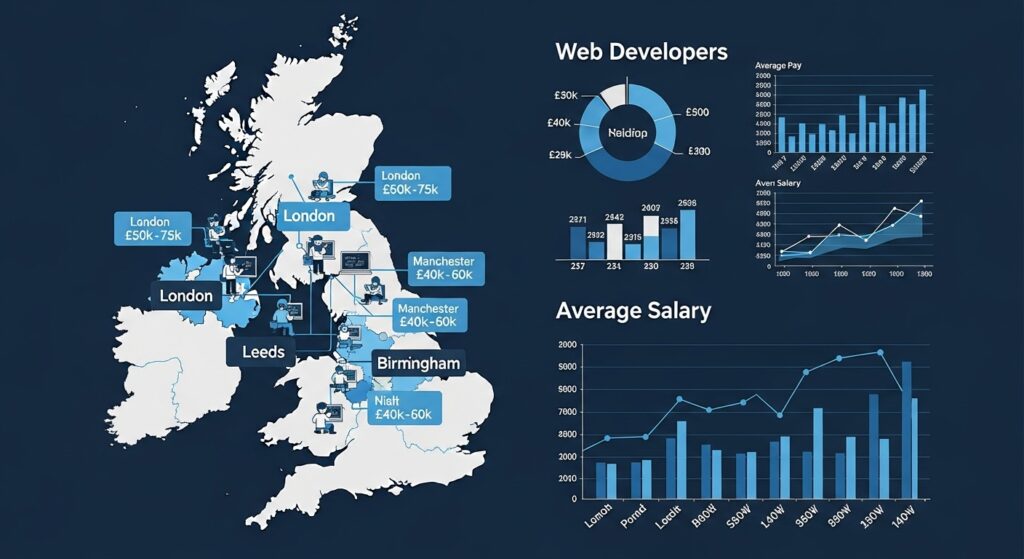
You’ll see that London and Manchester have a PS5,000 to PS15,000 difference in the price of the same job.
4. Salary by role/seniority levels
Here’s a more detailed look at how salaries typically evolve:
- Junior Web Developer: £20,000 – £30,000
- Mid-level / Developer: PS30,000 – PS45,000
- Senior / Lead Web Developer: PS45,000 – PS70,000+
- Technical architect / Head Development: 70,000-100,000+ PS
Prospects, for example, reports mid-level and senior positions in the PS30,000 to PS45,000 range. Leads go beyond PS50,000. Prospects
You can increase your rates faster if you are a specialist (for instance, in performance optimization or security).
5. Regional Differences in the UK (London vs Rest of UK).
Location matters a lot.
- Developers in London often receive a “London Weighting” to compensate for the higher cost of living. Some London roles report salaries above PS60,000. Glassdoor
- Salary is lower outside London, but so are the costs of living. A PS35,000 salary outside London is a good standard of living for many developers.
- In smaller cities, the roles may be in the lower middle range unless they are in a niche role or a senior position.
If you are evaluating a relocation or negotiating a job offer, compare the net benefit after costs and not only gross salary.
6. Freelance / Contract vs In-House Salaries
Contractors and freelancers often charge higher rates per hour, but there are tradeoffs.
- According to Indeed, the average salary for web developer roles in the UK is 46,054/year. Indeed
- If they are in high demand and skilled, contractors may charge up to 50% more per hour than a full-time salary.
When you decide to work as a freelancer, you must cultivated relationships, negotiate a good contract, and deliver on time.
7. How to Increase the Salary of Your Web Developer (Step by Step)
Here’s how to increase your income:
Step 1: Master Core Skill
You should be able to code in HTML, CSS, JavaScript and at least one of the backend stacks (Node.js or PHP, for example). Know frameworks (React Vue Angular, etc.) and version control.
Step 2: Create a strong portfolio
Real projects (personal, Open Source, Freelance) to showcase your work. Employers are looking for evidence of your work.
Step 3: Specialize & Learn Niche Skills
E.g. Performance optimization, security and web accessibility.
Step 4: Stay updated & get certifications
E.g. AWS, Google Cloud security credentials, etc. They are reliable.
Step 5: Engage in active negotiation
Ask for more when offered roles. Justifications can be based on comparison data (such as those shown above). You can say “based on the market data, I would expect X” instead of accepting the first offer.
Step 6: Change roles strategically
It is common to see salary increases of 5-15% when switching companies or roles.
Step 7: Freelance or Side Projects
Additional income can boost your earnings by a significant amount. You may eventually decide to become a full-time freelancer.
Step 8: Mentor / Lead / Architect Role
Pay increases are common when you move into leadership or architectural roles. Manage teams and take on bigger projects.
Your salary can increase by 5-10% if you consistently follow these steps.
8. Anecdotes and Real Stories
This is a story that will bring it to life.
Ayesha’s Journey in Leeds
Ayesha began her career as a junior developer in Leeds and earned about PS24,000. She worked nights on her personal projects, contributed to open source and improved her skills. In just 3 years, she became a senior programmer and joined a tech company in Manchester, earning £45,000. She then moved to a London-based startup and earned 55,000 in addition to bonuses. Later, she added freelance work to her income and pushed it over £70,000.
What is her trick? She did several things: she created side projects, specialized in performance, displayed her work and didn’t hesitate to ask for more.
Mark, in Bristol, took a job at PS32,000 but, after 18 months, presented data to his manager on his added value. (Faster pages, Lower infrastructure costs) He requested PS38,000 and got it without changing companies.
9. Pitfalls and Common Mistakes
Avoid these traps.
- Accepting low offers because “it is a foot in door”
- Negotiating or saying, “I am fine with whatever”, is not acceptable.
- Overestimating costs (taxes, commute, living expenses)
- Soft skills or communication skills are often ignored.
- Versatility is more important than sticking to just one stack
- Failing to update skills
By avoiding these mistakes, you will be able to command a higher salary.

10. How to Ask for a Raised & Negotiate
Negotiation is crucial. Here is a mini guide:
- Research Market Rates (Use this article’s Data)
- Document Your Impact (Faster features, Reduced Costs, Client Wins)
- Ask proactively, not passively
- Choose a range and put your preferred number in the middle
- Accept alternative rewards (bonuss, equity, budget for learning) or be ready to walk.
- Ask when the next review will be.
When you have confidence and can back up your requests with data, you will often get better offers.
11. Summary and What You Should Do Next
Let me summarize:
- The average salary for web developers in UK ranges between £30,000 and £40,000, depending on location, experience, and skill.
- PS50,000 – PS70,000+ can be achieved by senior, specialist or leadership roles.
- When freelancers have a strong clientele, they can earn more than the standard salary.
- Many factors–skills, location, specialization–determine final pay.
- Your salary can be increased by negotiating, implementing side projects, changing roles, and improving your skills.