
It’s an exciting time to be a Backend Developer jobs in the UK. Backend developers are needed by companies across all sectors, from e-commerce to fintech and SaaS to digital agencies. This article will explore what backend developers are, what jobs they can do, what skills you need, how much money to expect, and how you can make yourself a stronger candidate.
What is a Backend developer?
Backend developers work on the “server-side” of an application: the parts the users can’t see, but that power the entire experience. This includes:
- Designing and implementing Application Programming Interfaces (APIs) to let different parts of the system communicate with each other. Indeed+1
- Ensure data is stored and retrieved correctly. Indeed+1
- Writing server-side code–business rules and data processing. Integrations with other systems. Indeed
- Collaboration with front-end engineers, UX engineers, and other stakeholders in order to deliver features.
- Ensure the backend is performant, secure, testable, and maintainable.
The backend developer is responsible for ensuring that the systems “behind the scenes” work efficiently, reliably, and can scale to meet growth.
There are many different types of backend developer jobs in the UK
You may encounter the following roles and specialisations:
- Junior backend developer / Entry level : Usually 0-2 year’s experience. You will support existing systems, repair bugs, and build parts of new features.
- Backend Developer, typically 2-5 years of experience. You will own key modules, create APIs, increase performance and work independently.
- Senior backend developer: Five years or more. You will architect system components, make technical decisions, and mentor others.
- Lead/Principal Backend Engineer : Responsible for technical architecture, strategy and design across multiple services.
- Specialised Backend Roles: E.g., API developer, micro-services engineer, cloud-backend (AWS/GCP), data-backend, etc.
For example, the salary for a senior backend Python developer (Django, AWS), listed in London, was PS75,000 to PS85,000. This is for a permanent full-time role. Indeed
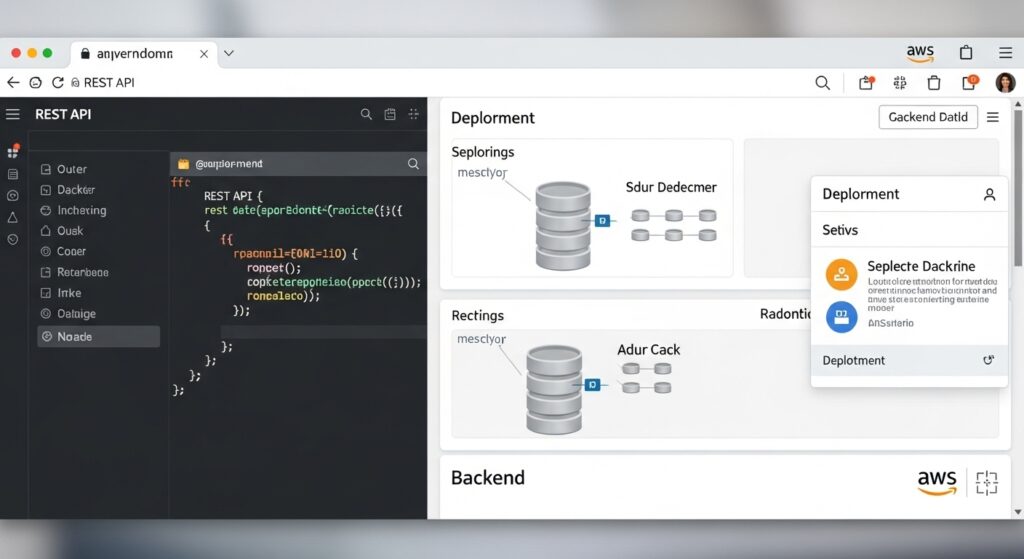
The Key Skills and Technologies You Need
You’ll need both technical skills and soft skill to succeed in backend positions. Here are the top five:
Technical Skills
- Proficiency in one or more backend programming languages/frameworks: e.g., Python (Django, Flask), Java (Spring), Node.js, Ruby on Rails, C#/.NET.
- Database knowledge: SQL (MySQL and PostgreSQL), NoSQL databases (MongoDB and Redis)
- Ability to design and implement APIs. Indeed
- Cloud platforms: AWS, GCP, Azure, containers (Docker and Kubernetes), Micro-services architecture.
- Performance tuning, scaling of systems, and security best practices.
- Test-driven development (TDD), continuous integration/continuous deployment (CI/CD).
Soft Skills & Process
- Debugging complex systems and analysing failures are key to problem-solving. Indeed
- Communication and collaboration: You’ll collaborate with designers, front-end developers, product managers, and QA. Indeed
- Understanding agile workflows (e.g. Git), version control (e.g. Git), and deployment pipelines.
- Documentation skills, and a maintenance mindset.
- Ability to adapt to changing systems and learn new technologies.
What are the salary expectations in the UK?
What salary can you expect as a UK backend developer (2025)? Here’s the breakdown:
- According to Jobtome the average salary of a backend programmer in the UK is PS65,000/year. Jobtome
- Indeed reports that the average salary in the UK is PS62.068/year. Indeed
- ITJobsWatch reports a median salary for this role of PS67500/year. IT Jobs Watch
- The median salary for roles outside London can be as high as PS60,000/year. IT Jobs Watch
- Entry-level roles or roles with less experience may be lower (e.g. PS30k to PS40k), while senior specialised roles can reach PS80k+. Himalayas+1
Remember that salary is heavily dependent on location, experience, company size, technology stack, hybrid/remote arrangements, and specialty.
How to Increase Your Chances for Landing a Job as a Backend developer
Take action:
- Create a portfolio
Develop sample projects, such as building APIs, creating backend services or deploying something in the cloud. Demonstrate that you are able to complete a workflow. - Get relevant experience
As a beginner, you can consider small freelance jobs, open-source contributions and internships.
At mid-level you should deepen your expertise (microservices architecture, system architecture or devops). - Be a master of one stack
It’s better to focus on one stack and be good at it than to spread yourself thin. - Learn the best practices Understanding testing, code quality and version control. Prepare to discuss these topics in an interview.
- Prepare yourself for interviews
The backend interview may include: algorithmic thinking (scale, architecture), system design (scale and architecture), database design, interface design, debugging. - Customize your LinkedIn
Highlight the backend achievements: services built, performance improvement, problem solutions. Mention your tech stack and quantify the results (e.g. “Reduced response time to API by 40 %”). - Continue to learn Stay up-to-date with the latest trends: cloud native architectures (serverless, microservices), containerisation, etc. Knowing the future is helpful.

What to expect from employers & the job market
- Most jobs offer hybrid or fully remote options.
- Some smaller companies expect you to wear several hats, including backend + devops and perhaps frontend.
- The backend teams of larger firms are often more defined, and they face greater challenges due to their size.
- Backend developers don’t only code, they also integrate with operations, product, and QA.
- Backend developers are in high demand on the UK job market, particularly those who have experience working with cloud environments and scalable systems.
- Due to demand, senior roles will be competitive but there are also opportunities for growth.
Final Thoughts
Backend developers in the UK have a promising career: high salaries, a growing market, varying technology stacks, and plenty of room for growth. If you are just starting out or want to move up, you will be well-positioned by building your skills and gaining experience.
To help you with your search, I’m happy to compile , a list 50 of the most current UK backend developer positions (with salary ranges and locations), job boards, job boards. Do you want me to go get it?