
In many cities around the globe, including the United Kingdom, construction and development projects are guided by more than just zoning regulations. They also follow a wider regulatory framework called a unified development code. This code is designed to help local authorities, developers, and communities manage land use, building design, and neighbourhood evolution.
Understanding the unified development code will help you navigate your permissions with confidence and avoid surprises.
This guide will cover:
- What is a Unified Development Code?
- These codes are based on the key elements.
- Why this code is important to developers and cities
- Avoiding common pitfalls
- How to Apply and Comply: A Step-by-Step Guide
- Anecdotes from real life to provide context
- What are the next steps?
What is a Unified Development Code (UDC)?
A unified development code (UDC) is a comprehensive document that local governments have adopted. It is a comprehensive regulatory document that combines land-use regulations such as subdivision rules, design guidelines and signage into a single framework. Partner Engineering and Science, Inc.+2Wikipedia+2
The UDC is a new system that aims to reduce regulatory overlap and provide clarity by consolidating all zoning, design, and building rules into a single “code”.
Key Characteristics:
- Document regulating development standards in one place
- Covers land use, building form, site design, public space, infrastructure
- This term is used to describe new construction, additions and, sometimes, redevelopment/infill
- Assists in aligning growth with the vision and plan of a city
is a unified code that explains what you can do and what you cannot.
Why the Unified Development Code is Important
A UDC can be highly valuable for a number of reasons, especially when it comes to a city.
- Predictability and clarity: Developers are aware of the standards that they must meet and can plan ahead. This reduces delays and costs.
- Better design outcomes. Because the code includes more form-based elements or design standards (not only “use” standards), it leads to better neighbourhoods that are walkable and high-quality.
- Efficient Permitting and Review With a single code, municipal reviews become clearer and quicker.
- Aligned City Vision: The UDC will be drafted to align with the comprehensive plan or masterplan of a city, ensuring that growth, densities and development patterns are in line with long-term goals.
- Less regulatory overlap : There is less duplication between building codes, zoning codes, and landscaping codes.
One industry resource noted: “A UDC (Unified Development Code) is a document that is adopted by the local municipality and often combines zoning and other code regulations for the development and construction of a property.”
Key Components in a Unified Development Code
You’ll find several sections when you open an UDC document. You can navigate the document more easily if you know what to expect.
- General provisions
- The code’s purpose and intent
- Definitions (e.g. “lot width”, build-to-line”, “mixed use”).
- Use of standards or zoning
- Land uses permitted by zone (residential/commercial/mixed-use).
- Building height, density limits and floor area ratios (FAR).
- Site design and building form
- Building orientation, setbacks, frontage requirements and parking placement.
- Streetscapes and pedestrian-friendly features
- Standards for sub-divisions and infrastructure
- How to divide land, necessary utilities, roads and sidewalks.
- Character-based design guidelines
- Materials, facade transparency, signage, and landscaping.
- Compliance and review procedures
- The process of reviewing site plans, obtaining permits and approving designs.
- Special districts and overlays
- Historic districts, transit-oriented areas, and sustainable development zones
- Administration and enforcement
- The code, its penalties, and how to appeal or amend it.
You can save time by understanding these codes. Instead of guessing where your project belongs, you can pinpoint it exactly.
How to read and use a Unified Development Code.
This is a workflow that you can use as a designer or developer to make the most of a UDC:
Step 1: Get the relevant code document
Download the latest version of your local UDC from the website of your city or local planning authority.
Step 2: Identify your Zone and project type
Decide whether you are building a new home, adding on to an existing house, or redeveloping your property.
Review the use and density standards
Check what land uses are allowed and the density/height limitations that apply. Ask: Am I allowed to use my land? Do I fall within the height/FAR limits?
Step 4: Review Building Form and Design Standards
Consider setbacks and frontage type, as well as parking requirements, and pedestrian needs. Make sure that your design adheres to building orientation and frontage regulations (e.g. build-to zones).
Step 5: Check Infrastructure Requirements and Subdivisions
Verify the infrastructure required for new developments: utilities, sidewalks and street trees.
Review Character Standards or Design Guidelines
If you have a design section, make sure your materials, signage and landscaping are in line. Include all required elements in your site plan, such as bike racks or green space.
Step 7: Prepare the Submission and Permitting Materials
Review the checklist and your site plan to ensure that you are following all code requirements.
Step 8: Submit your submission for review & track compliance
Submitting your design to the local authority is a good idea. You can track any comments and conditions.
Step 9: Build a Monitor
As you build, make sure that the plan is approved and that all code standards are followed. Any deviation could require amendment or waiver.
Follow these steps to increase your chances of a smooth approval.

Common Mistakes and How to Avoid Them
Even experienced players may stumble when working with a code of unified development. Here are some common mistakes to avoid.
- Assuming that all zoning regulations apply in every city Each municipality has a different UDC — the definitions and zones names are different.
- Ignoring design or frontage requirements You might check the land use, but forget that your building has to have a “primary frontage” along a road.
- Ignoring Infrastructure Requirements: In new subdivisions in particular, ignoring code requirements for lighting, sidewalks or trees can cause delays.
- Failing To Check Special Districts or Overlays: You might be in a district with special restrictions or an overlay for transit.
- Using outdated versions: Codes can be updated frequently; using an older version could mean you miss out on new standards or fees.
You can avoid expensive redesigns and delays by being proactive. Review carefully, ask clarifying questions, and perhaps hire a local code expert.
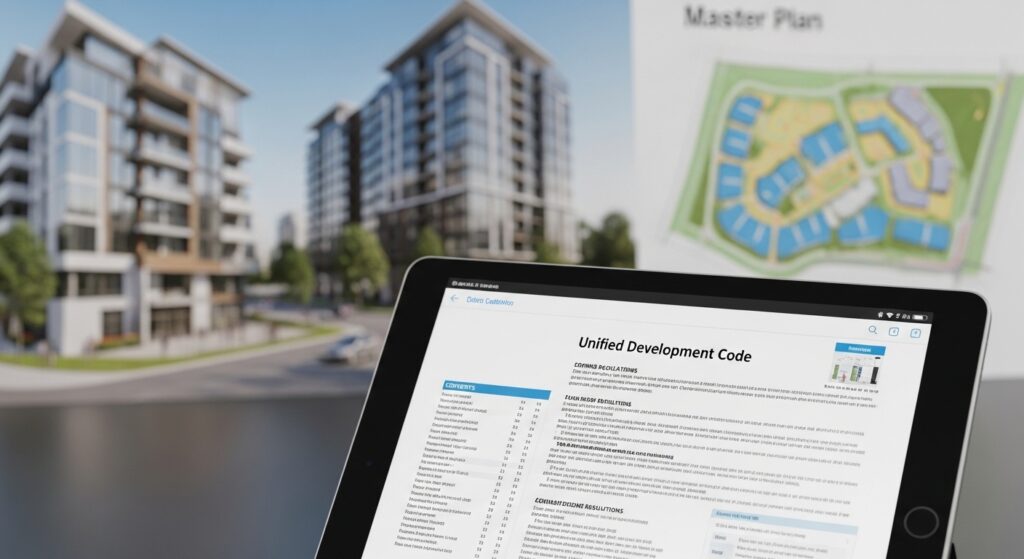
Anecdote – How One Developer Stopped Wasting Time by Using a UDC
Tell the story of GreenStreet Developments a Manchester property company. They bought a building site to build a mixed-use structure. They did not start the design process blindly, but instead studied the city’s unified development code.
The original plan, which had parking on the ground floor, would not pass because the frontage requirement of their zone required “active ground-floor use” to face the street. Recognizing this early, the designers redesigned the ground floor to include cafes and retail. They kept the parking behind and complied with the code.
Result? The site plan was approved on the first attempt, saving them months of rework. They avoided expensive redesigns by using the code for unified development.
Why the Unified Development Code gives you confidence
Understanding and aligning yourself with the UDC will help you:
- Clare guidelines: you know what’s allowed and what’s not
- Predictability: Reduced chance of surprises mid-project
- Standards help you get approved faster
- The quality outcome is better design, functionality and integration with the neighbourhood
- Compliance: Avoid fines and rework required due to nonconformance
You can proceed confidently, because your project is built upon a solid foundation.
Final Thoughts – Take Action Now
Find the unified development code that applies to your project. Use it from the first day. Download it and read all of its chapters.
Do you need help? Hire a designer or planner familiar with the UDC standards in your area and have them review your project before you start.