A good website in today’s digital world is not optional. It’s an essential. You need a great website if you want to build a brand or run an online store. It should also be easy to use and help people trust you. Web design and development services can help.
This guide will walk you through the following:
- What are “website development & design services”?
- What is the difference between Design and Development?
- Included in the price are core components and services
- They bring benefits & value
- Avoid these common mistakes
- The step-by-step guide for selecting a provider
- Real stories & anecdotes
- Why professional services give you confidence
- Summary and Action Steps
You’ll be able to tell what you are getting, why that matters, and which service you can rely on.
1. What are website design & development services?
When someone offers web design and development services, they are offering to create a new website or revamp an existing website so that it is visually appealing, functional, and aligned with the business goals.
The services that are usually provided include:
- Visual design (look, layout, user interface)
- Front-end Development (HTML/CSS, JavaScript, etc.)
- Back-end development includes servers, CMSs, data, APIs, and back-end components.
- Support for mobile devices (phones, tablets).
- Integration of a content management system (CMS), so you can edit the content.
- SEO foundations: Site structure, meta tags and clean code
- Cross-browser testing, quality assurance and testing
- Deployment and launch of the application, as well as hosting setup
- Support, maintenance and updates after launch
Design + development = A complete and working website.
Most UK agencies combine the two. Apply to Supply. Moreover, agencies stress the importance of combining “innovative designs with optimised codes” in order to create responsive and high-performance websites. Application to Supply
When you hire a “website development & design service,” you are hiring a team that can handle both the “looks” as well as the “brains.”
2. What is the difference between Design and Development?
They are often used interchangeably, but they have different meanings. Here’s how:
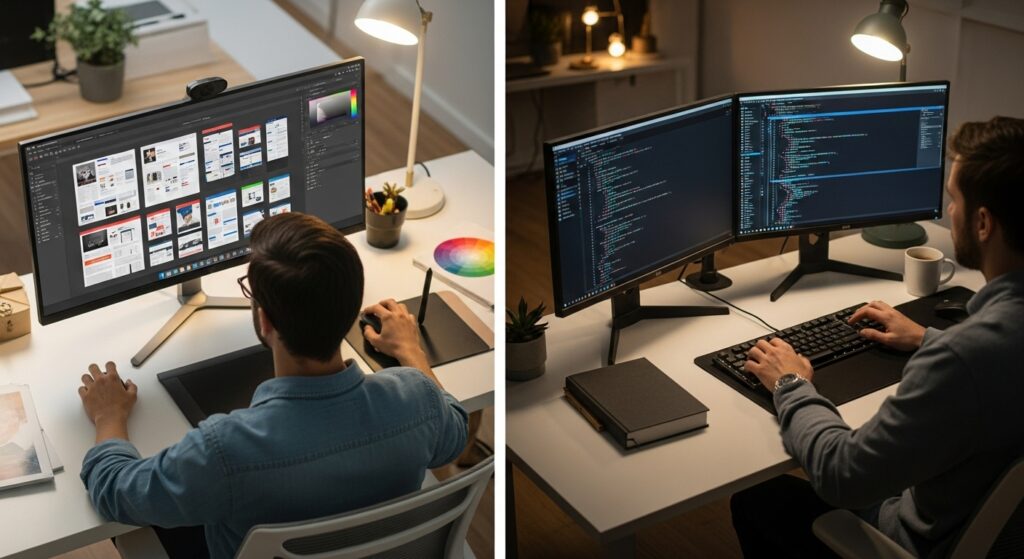
- Web Design focuses on how the website looks and how its users interact with it. Layout, color, typography and visual hierarchy are all part of web design. Wireframes and user interface (UI) are also included. Designers ensure that the site is attractive, intuitive, and brand-aligned. Intelivita UK+1
- Web Development is all about making work. Developers turn design mockups into working web pages. They build databases, integrate systems and optimize performance. Intelivita UK
Design and development are interdependent. A beautiful design will fail if the code is slow or broken.
3. Core Components & Services as a Full Package
Here are some of the most important things you should look for in a full-service provider:
3.1 Discovery & Planning
- Workshops for understanding your business, goals and audience
- Sitemap or site architecture
- Wireframes and mockups
- Content planning
3.2 Visual Design / User Interface
- Branding, color palette, font choices
- Page layouts of home, product, contact, about, etc.
- Prototyping (clickable designs)
Front-end Development
- HTML, CSS and JavaScript
- Responsive design (mobile, tablet, desktop)
- Interactive elements (sliders and animations)
3.4 Back-End development
- CMS (WordPress, Drupal, custom)
- Database / data models
- APIs and integrations (payment gateways CRMs, third party services)
3.5 SEO & Optimization Foundations
- Site speed tuning
- Clean URL Structure
- Meta tags, alt text, on-page SEO
- Image Optimization
Testing & Quality Assurance
- Cross-browser compatibility check
- Mobile/device testing
- Bug fixes, edge case handling
Launch & deployment
- Plan deployment (staging – live)
- Set up of the domain, DNS, and SSL
- Watchthe first hours/days
3.8 Maintenance and Support
- Updates (core, plugins)
- Security patches
- Ongoing tweaks, backups, and monitoring
Some providers also include hosting, analytics setup, conversion rate optimization, or UX audits.
A web design firm might set up email, server configuration, and hosting so that your site works smoothly after launch. madesimplemedia.co.uk
4. What You Get in Terms of Value & Benefits
Why should you pay for professional services instead of DIY or low-cost options? The following are some key benefits:
First Impressions and Credibility
It’s not uncommon for your website to be the first impression a client has of you. A polished site builds trust; a sloppy site drives people away.
Conversions & Better User Experience
A good design encourages users to take action (contact, purchase, sign up). Navigation, layout and performance are important.
Scalability and Flexibility
You can add tools and features to a well-designed site without having to rebuild it.
4.4 Performance and SEO
Mobile optimization, fast loading and clean code are all factors that improve rankings.
4.5 Long-term Costs Reduced
Reduce the number of mistakes, rework and downtime. In the long term, professional services are often cheaper.
4.6 Support and Peace of Mind
It’s important to have someone responsible for the software. This person can fix bugs, handle updates, and be contacted when something goes wrong.
5. What to avoid when choosing a service
Avoiding pitfalls is easier when you know what they are.
- Choose only the lowest priced – cheap is often a sign of low quality
- Not knowing what exactly is included in the scope of the contract
- After launch, there is no need for maintenance or support
- Checking portfolios and live work
- Ignoring mobile and responsive needs
- You may be overlooking SEO, security and performance.
- Requesting clear deadlines and milestones
6. How to choose the right service provider: A Step-by-Step guide
This is a guide to choosing the right partner for design and development:
Step 1: Identify your requirements and goals
- What features or functionalities do you require (blog, shop login, booking, etc.)?
- What are your budget, timeline and target audience?
- What are your brand guidelines and design aesthetics?
Step 2: Shortlist and References
- Check out the portfolios of web design companies
- Who built the sites you admire?
- Read reviews, case studies, and testimonials
Step 3: Ask for proposals and ask the right questions
The following should be included in the proposal:
- Scope & deliverables
- Timeline and milestones
- Cost & payment schedule
- What is included in post-launch maintenance?
- What platforms and technologies do they use?
Ask:
- Who will be the owner of the code?
- Will the site be responsive/mobile-first?
- (In the UK, accessibility is important under equality/discrimination laws) In the UK, accessibility plays a significant role in equality and discrimination laws. Wikimedia
- What happens if something breaks after launch?
Step 4: Begin with a pilot or MVP
Start with a small module (e.g. Test quality, communication and process by testing the homepage + core pages.
Step 5: Launch & Finalize contract
Once you are happy with the build, proceed to the full build, client interaction, review cycles and launch.
Step 6: Maintenance & Post-Launch
As part of your package, you should include ongoing support, security updates, backups and performance monitoring.

7. Real Stories & Anecdotes
I’d like to share with you a story.
A small artisan store in Bath used a low-cost web service. The site was launched late, contained broken links and was not mobile-friendly. Customers complained within weeks. They saw their revenue drop.
They then switched to a professional web design and development service. The new website loaded quickly, was easy to use, had a version for mobile devices, and beautifully reflected the brand. In just three months, they received 30% additional inquiries, and their bounce rates dropped dramatically.
Another story: An idea and logo were all that a startup had. We conducted discovery sessions, created wireframe,s and got their input. Then, we delivered a website that matched their brand. We improved the user flow through testing and feedback. The site was included in their first presentation to investors, and it was praised for its design.
These stories demonstrate that design and development can change perceptions, revenue and credibility.
8. Why you should feel confident about investing in these services
Is it safe to invest in this? When you follow the correct process, yes. Because:
- When you buy expertise instead of hours, you’re getting more than just hours
- Reduce risks (bugs and downtime, as well as security breaches).
- You can grow, use and show off your product.
- Credibility is important to clients and visitors
- Accountability and support are provided
Your investment will pay off with better conversions, smoother operation, and long-term revenue growth.
9. Summary and Action Steps
Here’s a quick recap:
- Website design & development services include design, coding, functionality, SEO fundamentals, launch, support
- The two disciplines of design (UI/UX), and development (code, Backend) are distinct yet integrated
- Key deliverables: discovery, responsive UI, CMS, testing, support
- Benefits: Better credibility, conversions and scalability. Peace of mind.
- Choose based on mobile and SEO, not just price or vague scope.
- Follow a step-by-step process: define your needs, shortlist the best candidates, propose pilots and then build.
- How good websites can change the results
- You can invest confidently with the right partner